Revenue Cycle Management: Market Overview
JULY 2026

JULY 2026
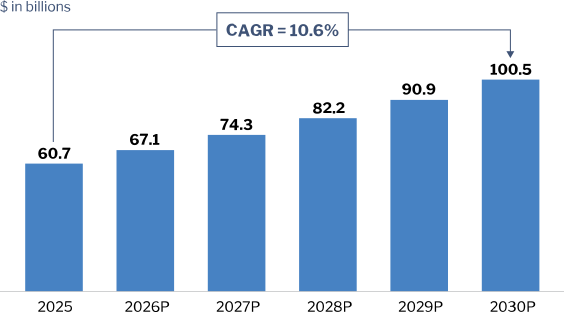
The U.S. RCM market is expected to grow at an annual rate of 10.1% and reach $306.7 billion by 2030. Rapid market growth is fueled by rising automation, outsourcing, and increasing complexity across billing, coding, and payer rules.

Elegibility & Patient Access. Verifies insurance coverage, benefits, and prior authorizations before care to reduce denials and ensure accurate financial responsibility upfront

Claims Management & Submission. Automates claim creation, scrubbing, coding validation, and electronic submission to payers, improving clean claim rates and speeding reimbursement

Denials Management and Appeals. Identifies denials, analyzes root causes, manages appeals workflows, and implements prevention strategies to recover revenue and reduce recurring rejections

Patient Billing & Collections. Manages patient invoicing, payment posting, collections, and payment plans to accelerate cash flow and improve patient financial experience
Sources: AMB database, Publicly available information
Leading operators signal convergence around AI automation, specialty services, complex claims recovery, and PE-led consolidation.

1. AI-Driven RCM Automation
Vendors are embedding AI and RPA into billing and denial workflows to automate repetitive tasks, reduce errors, and accelerate processing, streamlining operations while driving measurable revenue gains

2. Specialty-Focused RCM Services
Operators are targeting niche verticals with tailored workflows and specialized coding expertise to drive greater accuracy, faster speed, and stronger collections

3. Complex Claims & Liability Recovery
Vendors that specialize in complex, non-standard claims are seeing premium demand thanks to their specialized workflows and deep expertise in handling these challenging cases

4. PE Consolidation
The sector's fragmentation fuels potential consolidation, especially in specialized areas like behavioral health and oncology, where tailored RCM solutions can close workflow gaps




Sources: AMB database, Publicly available information
The combined impact of rising claims volume, complex payer rules, and persistent workforce shortages is heightening operational friction for health systems. This environment is driving sustained market demand for intelligent RCM tools capable of optimizing denials, collections, and revenue integrity.


Sources: AMB database, Publicly available information
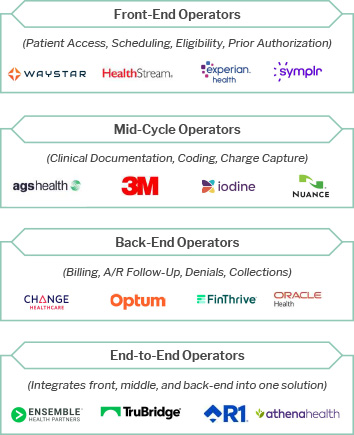
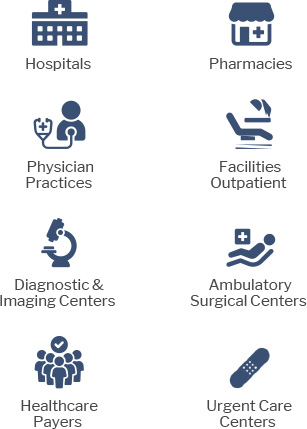
This ecosystem illustrates how healthcare end-users generate demand, how value is created across the revenue cycle workflow, and how solution providers deliver the technology and services that support it.
Vendors delivering technology, outsourcing, and workflow solutions across the RCM lifecycle including front-end, mid-cycle, backend, and full end-to-end models
The end-to-end administrative and financial workflow required to capture, manage, and collect patient revenue
Provider and payer organizations that generate demand for RCM support to manage billing, claims, and revenue across care settings
Sources: AMB database, Publicly available information
AI adoption in RCM is rising as providers seek scalable tools to streamline coding, authorizations, and back-end revenue recovery, modernize manual workflows, and unlock faster, more predictable cash flow, driven by margin pressure and a push to reduce denials.

AI-driven RCM (RPA, NLP, ML) cut Discharged, Not Final Billed (DNFB) by 50%, boosted coder productivity 40%, and raised Case Mix Index (CMI) by 4.6%

Automated coverage discovery and AI-generated denial appeals streamline workflows, using predictive models to guide write-offs

22% decrease in prior-auth denials, 18% fewer non-covered service denials, and 30–35 hours/week saved


Source: Publicly available information
Evolving federal and state regulations are adding complexity to billing, compliance, and workflows across the revenue cycle.
No Surprises Act (NSA): Establishes upfront cost estimates, bans surprise out-of-network billing, and mandates a dispute resolution process, raising documentation, estimation, and compliance requirements for providers and RCM vendors
Price Transparency Rules (Hospital & Payer)
Hospitals must publish negotiated rates; payers must offer real-time cost-sharing estimates. Requires accurate pricing data maintenance, tighter front-end workflows, and greater visibility
Interoperabiliy & Information Blocking (21st Century Cures Act)
Mandates open exchange of health information through APIs and prohibits data blocking and drives investment in data standards, eligibility integration, and interoperable RCM systems
Value-Based Care & Alternative Payment Model Frameworks
Expanding adoption of bundled payments, ACOs, and risk-based contracts requires RCM operators to track quality metrics, manage attribution, and reconcile shared savings/losses
HIPAA Security & Expanding State Privacy Laws
More stringent expectations for data protection, cybersecurity, and breach response, with states increasingly adding requirements beyond federal HIPAA standards

Margin pressure from declining Medicare rates, increasing uncompensated care, and Medicaid enrollment volatility (OBBBA work requirements, ACA subsidy risk)

Higher cost-to-collect due to more complex coding/documentation standards, greater audit exposure, and continuous compliance training needs

Required upfront investment in automation, AI, and secure infrastructure to meet evolving regulatory and payer expectations

Patient-centric rules such as income-based payment plans, charity care screening and dispute processes, are constraining traditional collections practices and increasing administrative load
Sources: AMB database, Publicly available information

Omry Bigger | President of Clinical Solutions, Elsevier | June 2026
"Clinicians today face a genuine tension: The patient data they need is in complex EHR systems, and the trusted evidence they need is somewhere else entirely. For health systems, this means governed AI at the point of care, built on verified content clinicians can trust and patient context they already have."
Doug Brown | Founder and President, Black Book Research | June 2026
"The next generation of hospital system RCM will be defined by payer intelligence, denial prevention, authorization readiness, front-end financial clearance, auditable AI, CFO-grade cash visibility and accountable managed operations working as one financial performance system."
Tony Morrison | VP & Chief Revenue Cycle Officer, Sanford Health | January 2026
"Automation is our top priority from a revenue cycle perspective in 2026. By reducing our reliance on manual processes, we can lower our cost to collect, improve accuracy and consistency and better support our revenue cycle teams."
Sources: AMB database, Publicly available information
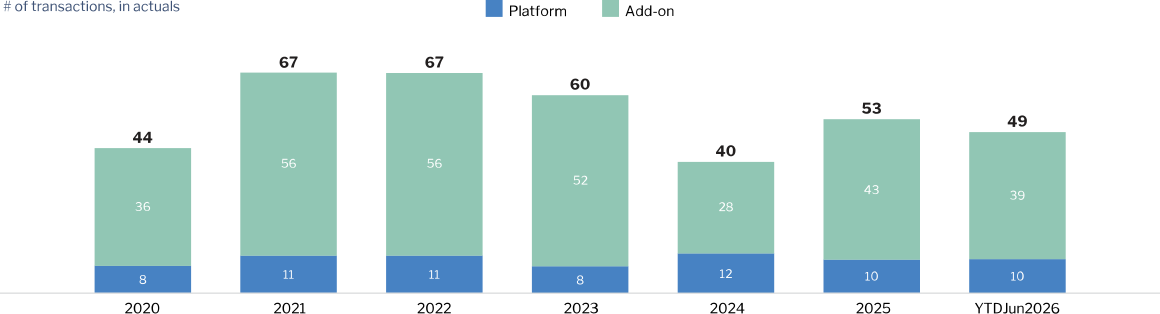
After a pullback in 2024, deal volume has rebounded meaningfully, with sustained buyer interest in companies leveraging AI and technology-enabled solutions and/or companies offering acceptable AI investment requirements to enhance RCM.

Value-Based Transition
The shift from fee-for-service to valuebased care is driving demand for more advanced RCM systems to manage bundled payments and quality metrics

Automation & AI Adoption
Growing use of AI, RPA, and cloud tools is streamlining billing, coding, and denial management, improving speed and accuracy across the revenue cycle

Increased Outsourcing
Health systems are increasingly outsourcing RCM to reduce costs, boost cash flow, and improve efficiency amid rising regulatory and financial pressure

High Implementation Costs
Upfront investment in RCM systems, including software, training, and IT support, can be cost-prohibitive, especially for smaller providers

Data Security Risks
RCM platforms manage sensitive patient data, creating ongoing cybersecurity and HIPAA compliance risks for healthcare organizations

Regulatory Complexity
Frequent payer policy changes and shifting regulations complicate claims processes, increasing denial rates and compliance burdens
Sources: AMB database, Publicly available information
| Date | Seller | Buyer | Description |
|---|---|---|---|
| Jun-26 | CanAide | Med-Metrix | Intelligent automation and revenue cycle platform for hospitals and health systems; combines RPA, AI-driven denial prevention, and patient enrollment support |
| May-26 | Knack RCM, EqualizeRCM | Carlyle | Revenue cycle outsourcing platform for hospitals and health systems; consolidated a PE-backed scale position in healthcare RCM services. |
| Apr-26 | Jopari Solutions | Office Ally | Electronic billing and payment network for workers' comp and auto-injury claims; extended acquirer's specialty payments infrastructure across payer-provider channels. |
| Mar-26 | Saisystems Health | Serent Capital | Business process outsourcing platform for physician billing and coding; strengthened acquirer's multi-specialty RCM services footprint. |
| Jan-26 | HealthAxis Group | HandsOn Global Management | Core administrative processing and BPO platform for health plans; advanced acquirer's build-out in Medicare Advantage and Medicaid technology infrastructure. |
| Nov-25 | MedEvolve | Emergence | Practice management and RCM analytics platform for medical groups; enhanced acquirer's workflow automation and revenue performance capabilities. |
| Sep-25 | Precision Practice Management | Vee Healthtek | Specialty-focused medical billing platform for anesthesia and radiology groups; expanded acquirer's presence in hospital-based specialty RCM. |
| Aug-25 | Knack Global | Carlyle Group | Healthcare and insurance BPO platform spanning RCM and claims processing; scaled acquirer's offshore-delivery outsourcing model. |
| Aug-25 | Sage Clinical RCM | YES HIM Consulting | Clinical billing and coding services platform for physician practices; supported acquirer's regional RCM consolidation strategy. |
Sources: Publicly available information
Healthcare providers are shifting RCM from a back-end billing function to an upstream, revenue protection strategy, using AI, clinical integration, and analytics to prevent denials, defend reimbursement, and manage growing payer and patient-pay complexity.
Providers are deploying automation, predictive analytics, and AI to reduce denials, improve billing accuracy, and proactively prevent revenue leakage
RCM is adapting to value-based care, higher patient responsibility, and telehealth, driving demand for more data-driven, digitally enabled billing and engagement capabilities
Staffing shortages, regulatory complexity, and cost pressure are accelerating the move toward end-to-end outsourced and technology-enabled RCM services
| Participant | Description |
|---|---|
 |
Provider of cloud-based healthcare IT solutions, with RCM services that support medical practices and health systems across patient access, medical coding, claims submission, denial management, and collections |
 |
Provider of healthcare technology and business solutions offering clinical decision support, payment accuracy, and end-to-end RCM for providers, payers, partners, and patients |
 |
Provider of end-to-end RCM services for hospitals and health systems, covering patient access, coding, billing, collections, and analytics to improve cash flow, revenue integrity, and operational efficiency |
 |
Provider of ambulatory-focused healthcare IT solutions, including EHR and integrated RCM services covering scheduling, billing, claims management, and collections |
 |
Healthcare IT and data-analytics business unit of Experian, focused on RCM, patient access, identity management, and data-driven decision support for hospitals, health systems, and physician groups |
 |
Provider of healthcare technology and services across data analytics, care delivery, and RCM, supporting providers and payers with patient access, coding, billing, payment integrity, and revenue optimization |
 |
Provider of RCM services for hospitals, health systems, and physician groups, delivering end-to-end support across personnel, technology, and workflows |
 |
Provider of payer-integrated healthcare IT and RCM solutions, including claims management, reimbursement analytics, and revenue optimization tools |
Sources: AMB database, Publicly available information
| Company | Backing | Date | Service Focus | Locations | Growth Strategy | Recent Acquisitions |
|---|---|---|---|---|---|---|
 |
 |
May-26 | RCM consulting Credentialing Medical coding |
USA (12) India (6) Philippines (1) |
Leverage Carlyle capital to scale organically and via M&A, expanding specialty and geographic RCM capabilities | N / A |
 |
 |
Jan-26 | Pediatric billing Claims & denials management |
USA (1) | Defend pediatric-only focus as a moat against generalist RCM vendors | N / A |
 |
 |
Aug-25 | Medical coding Patient access and financial management |
USA (2) Mexico (1) India (7) Philippines (1) |
Leverage AI-driven automation and global delivery centers to expand RCM services and grow with large health-system clients |  |
 |
 |
Jun-25 | Patient intake Revenue integrity and collection |
USA (6) India (1) Philippines (1) |
Leverage growth capital to scale organically and via M&A, expanding RCM/BI capabilities |  |
 |
 |
Apr-25 | Modular RCM with AI agents and human operators Clinical insights and revenue optimization |
USA (2) Global service centers (24) |
AI integrations from mergers, modular RCM solutions, and scaling to $200B revenue management |  |
 |
 |
Dec-24 | Patient access Remote monitoring Mid-Revenue cycle |
USA (4) India (7) Colombia (1) Philippines (2) |
Bolstering nearshore delivery and heavy tech investments to advance its strategic end-to-end solutions |  |
 |
 |
Nov-24 | Pre-registration Financial counseling Charge capture Medical coding Denials management |
USA (13) India International (9) |
Focus on expanding its business through market penetration, service diversification, AI innovation and strategic acquisitions |  |
 |
 |
May-24 | Patient access Medical coding A/R optimization |
USA (4) India (4) |
Acquire AI/RCM assets while scaling agentic automation across patient access workflows |  |
Sources: Publicly available information
EHR, EMR and Practice Management
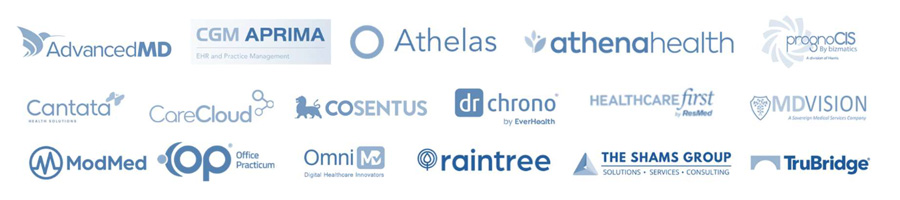
End-to-End RCM Platforms
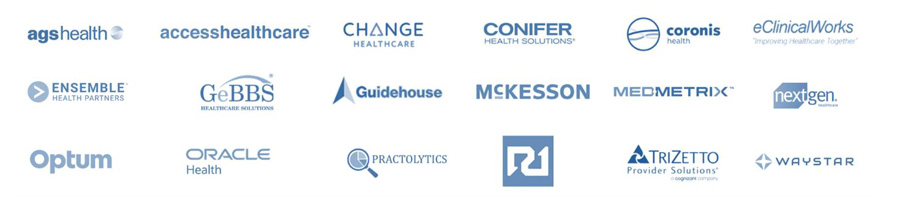
Care Management Enablement
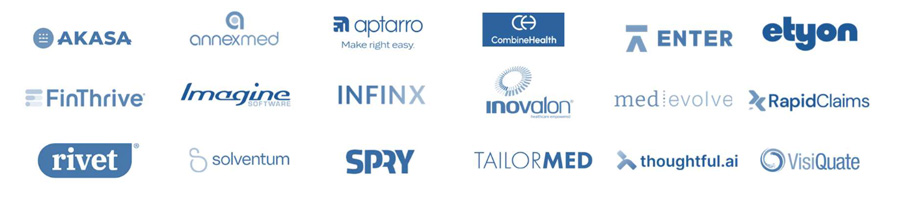
Sources: AMB database, Publicly available information
Care Management & Coordination / Enablement

Revenue Integrity, Denials & Payment

Patient Financing & Payments

Prior Authorization

Patient access & intake automation

Sources: AMB database, Publicly available information
Post-Acute Care & Skilled Nursing

Behavioral

Dental

Medical Nutrition Therapy (MNT) / Nutrition

Women's and Maternal Health

Radiology / Imaging

Laboratory / Pathology

Sources: AMB database, Publicly available information
Allen Mooney & Barnes Brokerage Services is a broker/dealer member of FINRA and SIPC. Allen Mooney & Barnes Investment Advisors, Inc. is an investment adviser registered with the U.S. Securities and Exchange Commission.
Information presented in this document is for informational, educational and illustrative purposes only. While the information in this document is from sources believed to be reliable, the AMB companies make no representations or warranties, express or implied, as to whether the information is accurate or complete and assume no responsibility for independent verification of such information. In addition, the analyses in this document are narrowly focused and are not intended to provide a complete analysis of any matter.
Past performance is not necessarily indicative of future performance. Estimates, projections or indications of future performance can be identified by certain statements, such as "believes," "expects," "may," "will," "should," "seeks," "approximately," "plans," "estimates" or "anticipates" or the negative of those words or other comparable terminology, as well as by statements concerning projections, future performance, developments, events, revenues, expenses, earnings, run rates and any other guidance on present or future periods. Any such statements are forward-looking in nature and involve risks and uncertainties. Any statements of future performance are based on assumptions that might not be realized and a number of factors, including without limitation, the volatility of the securities markets, the overall environment for interest rates, risks associated with private equity investments, the demand for public offerings, activity in the secondary securities markets, competition among financial services firms for business and personnel, the effect of demand for public offerings, available technologies, the effect of government regulation and of general economic conditions on our own business and on the business in the industry areas on which we focus and the availability of capital to us. We are under no obligation to update the information presented in this document or to inform you if any such information turns out to be inaccurate or misleading.
The information in this document is not, and is not to be construed as, an offer or a solicitation to buy or sell any securities or any other financial instruments or a recommendation or endorsement to engage in or effect any particular investment or transaction. Moreover, under no circumstances should the information in this document be considered legal, tax or accounting advice or relied upon, therefore. The recipient is advised to rely on the advice of its own professionals and advisors for such matters and should make an independent analysis and decision regarding any transaction based upon such advice.
The information in this document is not intended for distribution to, or use by, any person or entity in any jurisdiction or country where such distribution or use would be contrary to law or regulation or for any distribution or use that would subject the AMB companies to any registration requirement within such jurisdiction or country.
The information contained within this presentation is derived exclusively from publicly available resources that we believe to be reliable. No proprietary data, non-public information, or issuer-supplied materials were used in preparing this content.
677 King Street, Suite 410 | Charleston, SC 29403
AMB focuses on lower middle-market healthcare niches where consumerism and fragmentation meet to disrupt traditional healthcare channels. We typically advise companies with EBITDA of $5M to $20M and an average enterprise value of $100M, but will move up and down the spectrum. AMB's research-oriented approach to business development has resulted in a vast network of strategic and financial sponsor relationships that yield industry leading intelligence and optimal outcomes for our clients.
Managing Director
843-501-2183 Direct
mikel.parker@ambadvisors.com
Managing Director
843-405-1108 Direct
ryan.loehr@ambadvisors.com
Vice President
843-371-8596 Direct
johnny.cross@ambadvisors.com
Analyst
843-271-5652 Direct
brayden.sarathy@ambadvisors.com
Analyst
843-576-4711 Direct
bella.worthington@ambadvisors.com
Associate
860-510-2244 Direct
evan.migdole@ambadvisors.com